.png?width=290&height=50&name=image_1%20(1).png "image_1 (1)")
As innovation in cosmetic and nutraceutical products accelerates, the demand for scientifically validated ingredients continues to grow. Consumers are no longer satisfied with claims, they expect visible, measurable results.
One ingredient gaining increasing attention is silica, an essential trace mineral known for its key role in collagen synthesis and tissue health.
Recent research highlights how silica supports the body through multiple biochemical pathways. It is now recognized as a critical factor in collagen formation, stability, and functionality.
Overview of Collagen Synthesis
Collagen is the most abundant protein in the human body, accounting for nearly 30% of total protein content. It provides structural support to:
- Skin
- Hair
- Nails
- Bones
- Connective tissues
Its continuous synthesis is essential for maintaining strength, elasticity, and tissue integrity.
To date, 29 types of collagen have been identified. These differ in structure, distribution, and biological function. Among them, types I–V are the most common, each playing a specific role.
All collagen types share a common feature: a triple helix structure, formed by three intertwined α-chains.
Type I Collagen: The Structural Backbone
Type I collagen is the most abundant form in the body. It is composed of:
- Two α1(I) chains
- One α2(I) chain
These chains assemble into highly organized fibrils made of nearly 1,000 amino acids, forming strong and flexible structures.
This organization makes type I collagen essential for tissue strength and mechanical resistance.
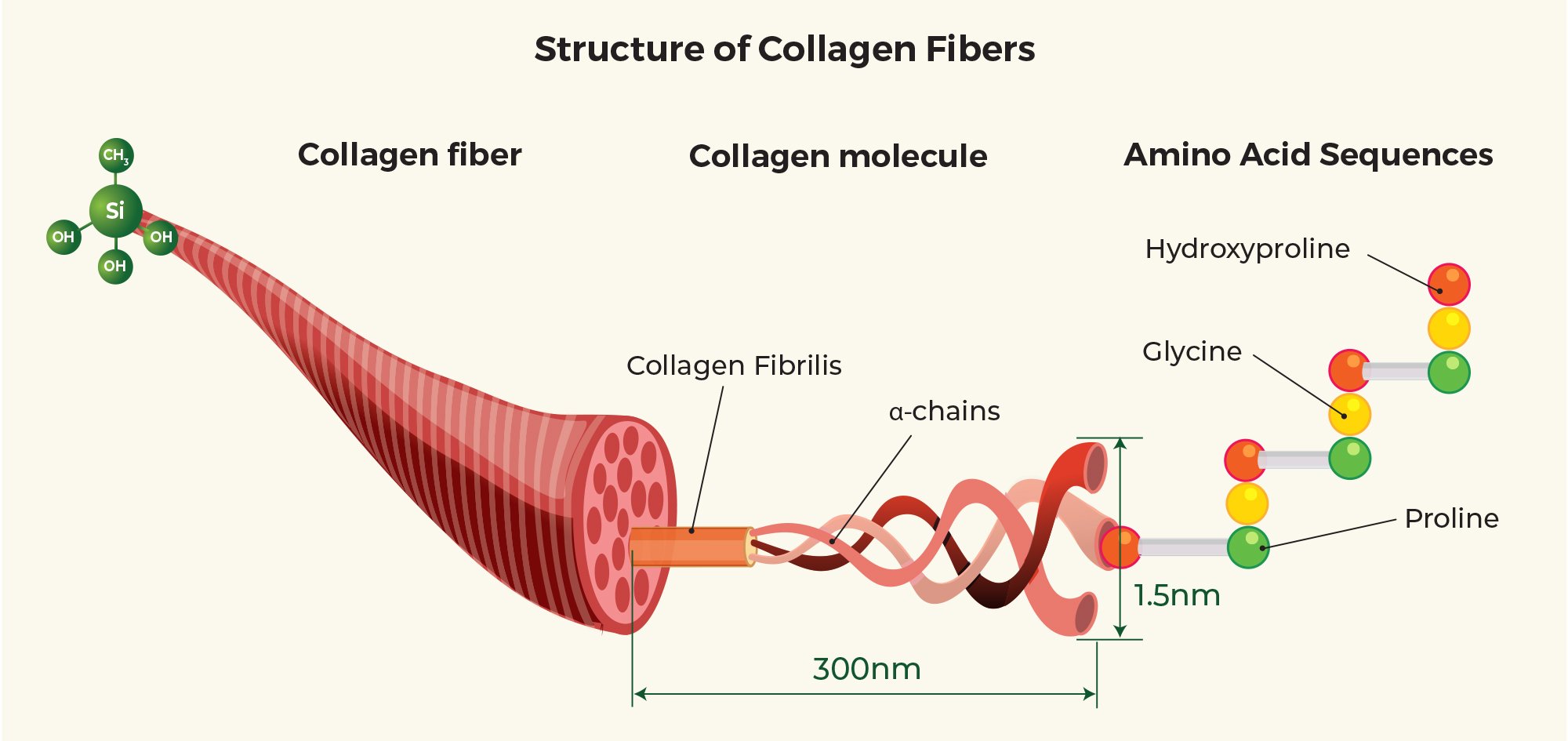
Figure 1. Structure of collagen fibers from fibrils and molecules to chains and amino acid sequence: Hydroxyproline, Proline, Glycine.
Molecular Structure of Collagen
At the molecular level, collagen follows a repeating sequence:
Glycine–X–Y
- Glycine appears in every third position
- X and Y are often proline and hydroxyproline
This structure is critical because:
- Glycine allows tight packing of the helix
- Hydroxyproline stabilizes the structure
- Hydroxylysine contributes to cross-linking
These features give collagen its strength and durability.
The Essential Role of Silica in Collagen Synthesis
Collagen production occurs mainly in fibroblasts, specialized cells responsible for building connective tissue.
This process depends on more than amino acids. It also requires enzymes, cofactors, and key minerals.
Silica plays a crucial role by:
- Stimulating type I collagen synthesis
- Enhancing glycosaminoglycan (GAG) production
- Supporting enzymatic activity involved in collagen formation
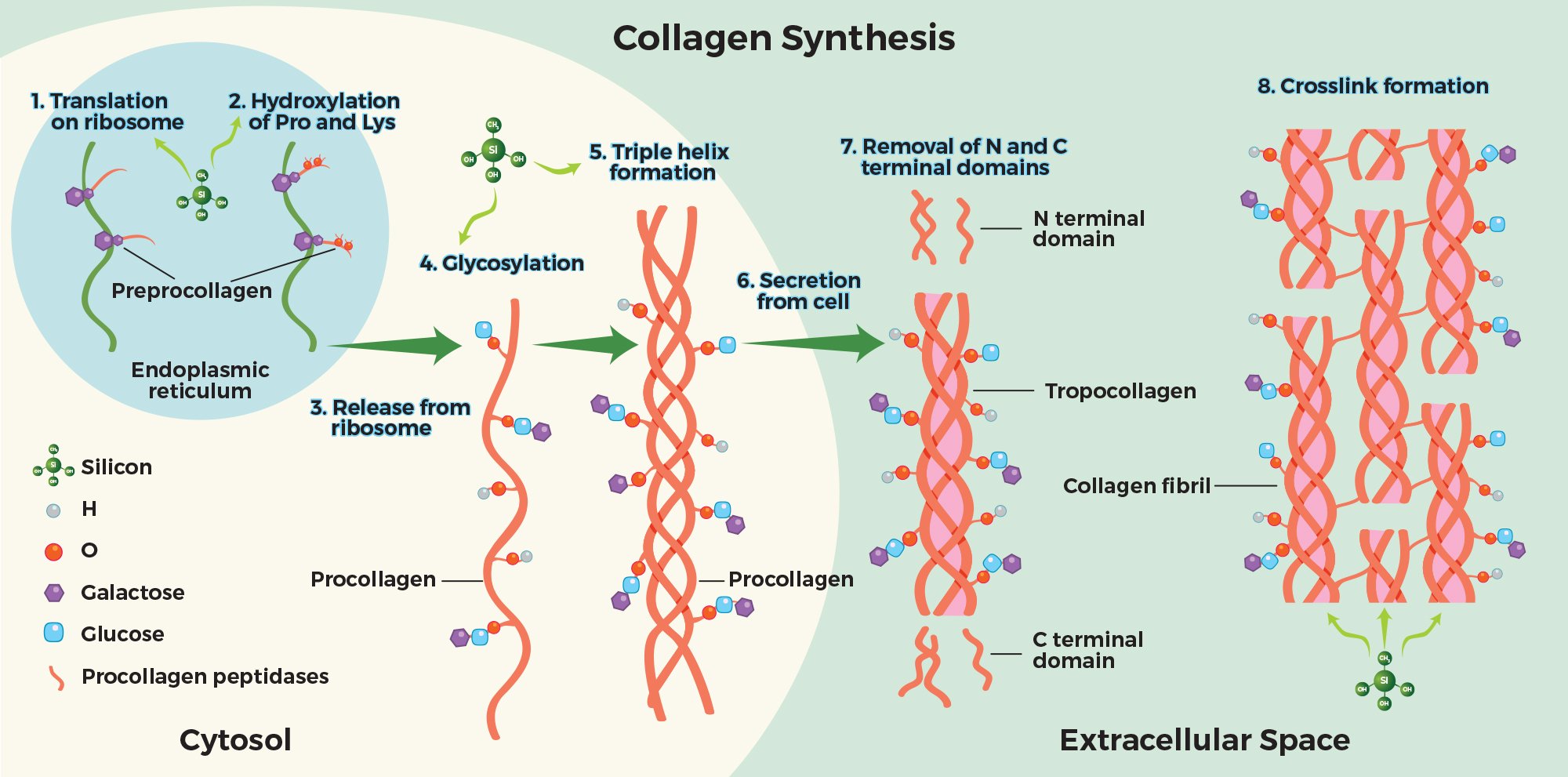 Figure 2. Collagen synthesis process.
Silica and Enzymatic Activation
One of silica’s most important functions is its effect on hydroxylation, a key step in collagen synthesis.
This process stabilizes the collagen structure and occurs in the endoplasmic reticulum.
Silica enhances the activity of enzymes such as:
- Prolyl hydroxylase
- Lysyl hydroxylase
These enzymes:
- Add hydroxyl groups to proline and lysine
- Enable proper formation of the triple helix
- Improve collagen strength and stability
Beyond Collagen: Structural Support
Silica also interacts with the extracellular matrix by:
- Supporting glycosaminoglycans (GAGs)
- Promoting osteoblast differentiation
- Enhancing connective tissue organization
These actions contribute to:
- Improved elasticity
- Greater durability
- Stronger skin, hair, nails, and bones
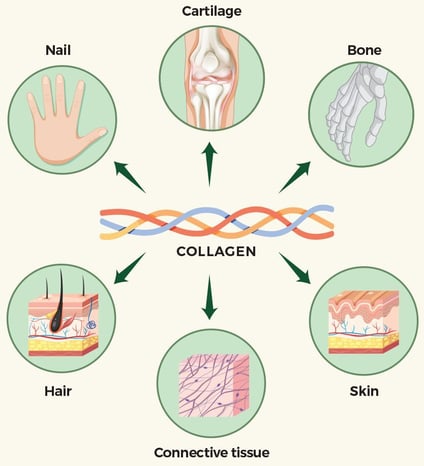 Figure 3. Collagen is the main structural protein in the connective tissues, cartilages, bones, nails, skin and hair.
Setting New Standards in Supplement Formulation
Incorporating silica into formulations represents a strategic advantage for product developers.
As demand for science-backed solutions increases, silica stands out as a key innovation driver in the beauty and wellness space.
At Silicium Laboratories, we are committed to advancing the science of silica. Our ingredients are designed to:
- Deliver high bioavailability
- Support collagen production
- Meet the highest standards of quality and efficacy
We help brands develop next-generation silica-based products that lead the market.
Contact Us:
For more information:
- +1 (305) 779-0171 | (877) 454 2486
- lab@orgonolivingsilica.com
Or fill out the form:
get more information
about our ingredients
LEARN MORE ABOUT
SILICA