.png?width=290&height=50&name=image_1%20(1).png "image_1 (1)")
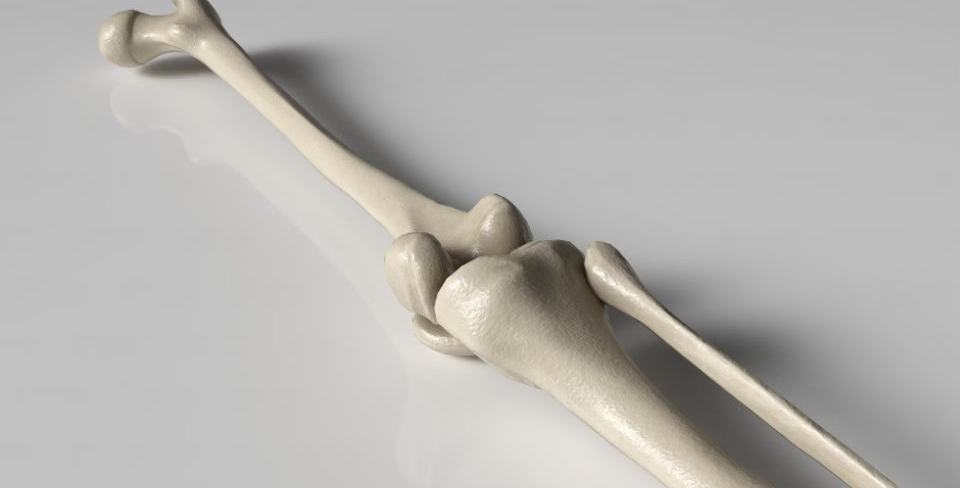
Bone health remains a key focus area in nutraceutical development, particularly in the context of aging populations and active lifestyles. Among emerging ingredients, bioavailable silicon has gained attention for its association with bone formation processes and connective tissue structure.
Silicon and Osteogenesis
Osteogenesis, the process of bone formation, involves the coordinated development of collagen matrices and mineral deposition.
Scientific literature suggests that silicon is associated with:
- Collagen-related pathways involved in bone matrix formation
- Early stages of mineralization
- Structural organization of developing bone tissue
Early studies, including those by Carlisle, have highlighted a potential relationship between silicon and bone development, particularly in the context of collagen synthesis and mineralization processes.
Role in Bone Mineralization
Bone strength depends on the formation of a mineralized matrix, primarily composed of calcium phosphate in the form of hydroxyapatite (Ca₁₀(PO₄)₆(OH)₂).
Bioavailable silicon has been associated with:
- Processes related to calcium and phosphorus deposition
- Formation and organization of mineralized structures
- Early-stage development of bone matrix
Experimental research has also explored its relationship with osteoblast activity (Reffitt et al., 2003), suggesting a potential role in cellular processes involved in bone formation.
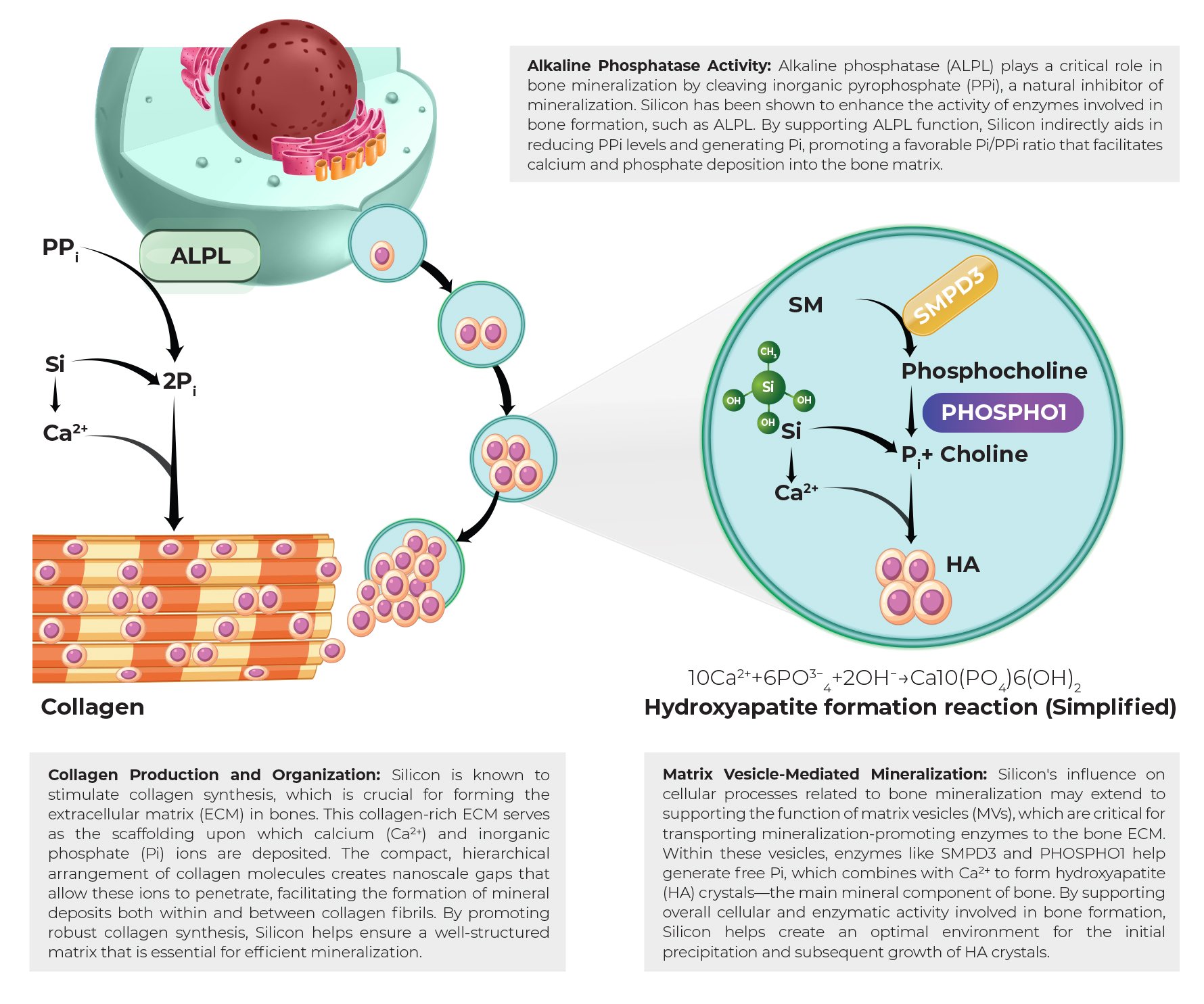 Figure 1. Model of bone mineralization.
Interaction with Collagen Matrix
Collagen provides the structural framework upon which mineralization occurs. (See post: The Importance of Silica in Collagen Synthesis: Biochemical Mechanisms)
Silicon is associated with:
- Collagen matrix organization
- Structural integrity of connective tissues
- Support of extracellular matrix formation
This relationship is particularly relevant in formulations targeting both bone strength and connective tissue support.
Scientific Context
Studies published in journals such as the Journal of Trace Elements in Medicine and Biology have explored the relationship between silicon intake and bone-related parameters.
Findings suggest associations with:
- Bone mineralization processes
- Connective tissue structure (See post: LIVING SILICA® Strengthens Joints, and Connective Tissues Naturally)
- Osteoblast-related activity
While research is ongoing, these observations support the inclusion of bioavailable silicon forms in bone health formulations.
Formulation Relevance of Bioavailable Silicon
The effectiveness of silicon in nutraceutical applications depends on its chemical form and stability.
LIVING SILICA® incorporates stabilized monomethylsilanetriol (MMST), designed to:
- Remain soluble and bioavailable (See post: An Innovative Silicon-Based Ingredient: Combining Bioavailability and Acacia Gum)
- Avoid polymerization into inactive forms
- Support consistent absorption profiles
This makes it suitable for integration into bone health and structural support formulations.
Positioning Opportunities in Bone Health Products
LIVING SILICA® can be used to support product concepts focused on:
- Bone structure and density support
- Connective tissue integrity
- Active lifestyle and healthy aging
- Multi-benefit formulations (bone + joints + collagen-related structures)
It can also complement traditional bone health ingredients such as calcium, vitamin D, and magnesium.
Supporting Next-Generation Bone Health Formulations
As the bone health category evolves, there is increasing interest in ingredients that go beyond mineral supplementation to support structural and functional aspects of bone tissue.
Bioavailable silicon offers a complementary approach aligned with this trend, enabling more comprehensive formulation strategies.
Technical Documentation and Formulation Support
For specifications, scientific documentation, or formulation guidance:
- +1 (305) 779-0171 | (877) 454 2486
- lab@orgonolivingsilica.com
Or fill out our contact form to connect with our team:
get more information
about our ingredients
LEARN MORE ABOUT
SILICA