.png?width=290&height=50&name=image_1%20(1).png "image_1 (1)")

Silicon is one of the most abundant trace elements in the human body, and its concentration in blood is similar to that of other elements essential for life (iron, copper, and zinc). It is found in tissues such as:
- Blood vessel walls
- Bone and cartilage
- Skin, hair, and nails
For nutraceutical development, understanding how silicon is absorbed, distributed, and utilized is critical to selecting effective ingredient systems.
Silicon in the Diet and Human Physiology
Dietary silicon is found in sources such as:
- Cereals and grains
- Fruits and vegetables
- Nuts and plant-based foods
- Drinking water
However, naturally occurring silicon is often present in forms with limited bioavailability, which can restrict its functional contribution.
Why Chemical Form Matters in Formulation
Silicon can exist in multiple chemical forms, each with different characteristics:
- Solubility in aqueous systems
- Stability over time
- Tendency to polymerize
- Absorption potential
Highly polymerized forms (e.g., silica, silicates) tend to be poorly absorbed, while stabilized, low-molecular-weight forms are more suitable for nutraceutical applications.
Monomethylsilanetriol (MMST) as a Bioavailable Form
MMST (CH₃Si(OH)₃) is a stabilized derivative of Orthosilicic acid (OSA), designed to improve:
- Solubility in aqueous environments
- Resistance to polymerization
- Compatibility with biological systems
Its molecular structure supports its use in formulations requiring consistent absorption and stability. (See post: LIVING SILICA’s Innovation: Unlocking Bioavailability for Better Results)
Overview of Silicon Absorption (ADME Framework)
The behavior of silicon in the body can be described using the pharmacokinetic framework of Absorption, Distribution, Metabolism, and Excretion (ADME).
A) Gastrointestinal Absorption
Following oral intake, bioavailable silicon forms:
- Remain stable under gastrointestinal conditions
- Are primarily absorbed in the small intestine
- Can cross the intestinal barrier via passive diffusion
Low molecular weight and solubility are key factors influencing this process.
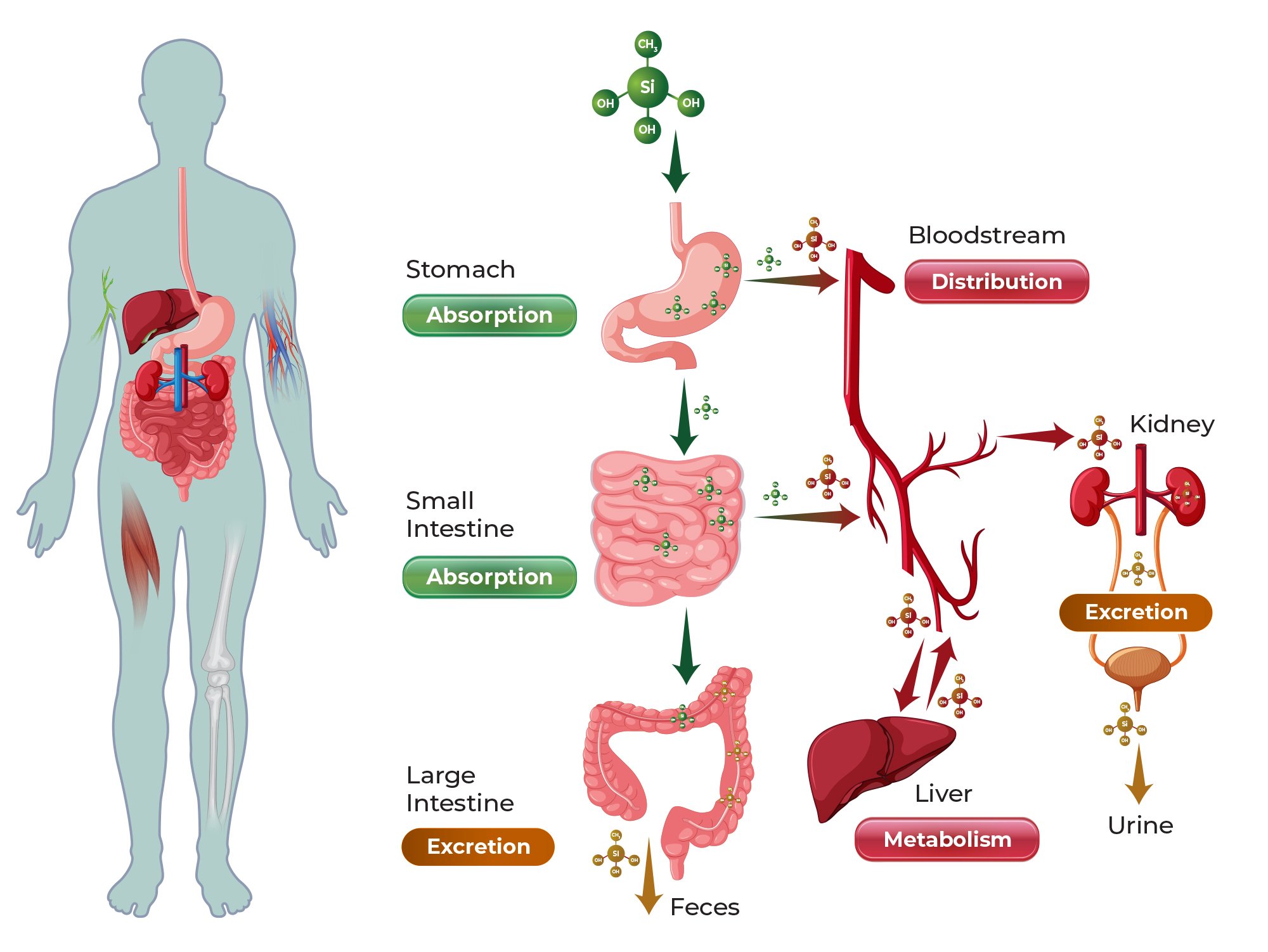 Figure 1.
The four processes of silicon absorption are based on pharmacokinetics: absorption, metabolism, distribution, and excretion.
Figure 1.
The four processes of silicon absorption are based on pharmacokinetics: absorption, metabolism, distribution, and excretion.
B) Transport in the Bloodstream
After absorption:
- Silicon circulates in soluble form
- It is distributed systemically to different tissues
- Plasma levels may increase shortly after ingestion
This systemic availability enables interaction with structurally relevant tissues.
C) Tissue Distribution
Silicon is associated with tissues involved in structural and connective functions, including:
- Bones (See post: The Role of Silica in Osteogenesis: Enhancing Bone Health and Density)
- Joints and connective tissue (See post: LIVING SILICA® Strengthens Joints, and Connective Tissues Naturally)
- Skin, Hair and nails (See post: LIVING SILICA® Supports Healthy Skin, Stronger Hair and Nails)
It is linked to biological processes such as:
- Collagen-related pathways
- Extracellular matrix organization
- Mineralization processes
D) Elimination and Regulation
Silicon homeostasis is regulated by the body:
- Excess silicon is primarily excreted via the kidneys
- Urinary excretion is the main elimination route
- Retention occurs in tissues where it is functionally relevant
This contributes to its generally favorable safety profile when used appropriately.
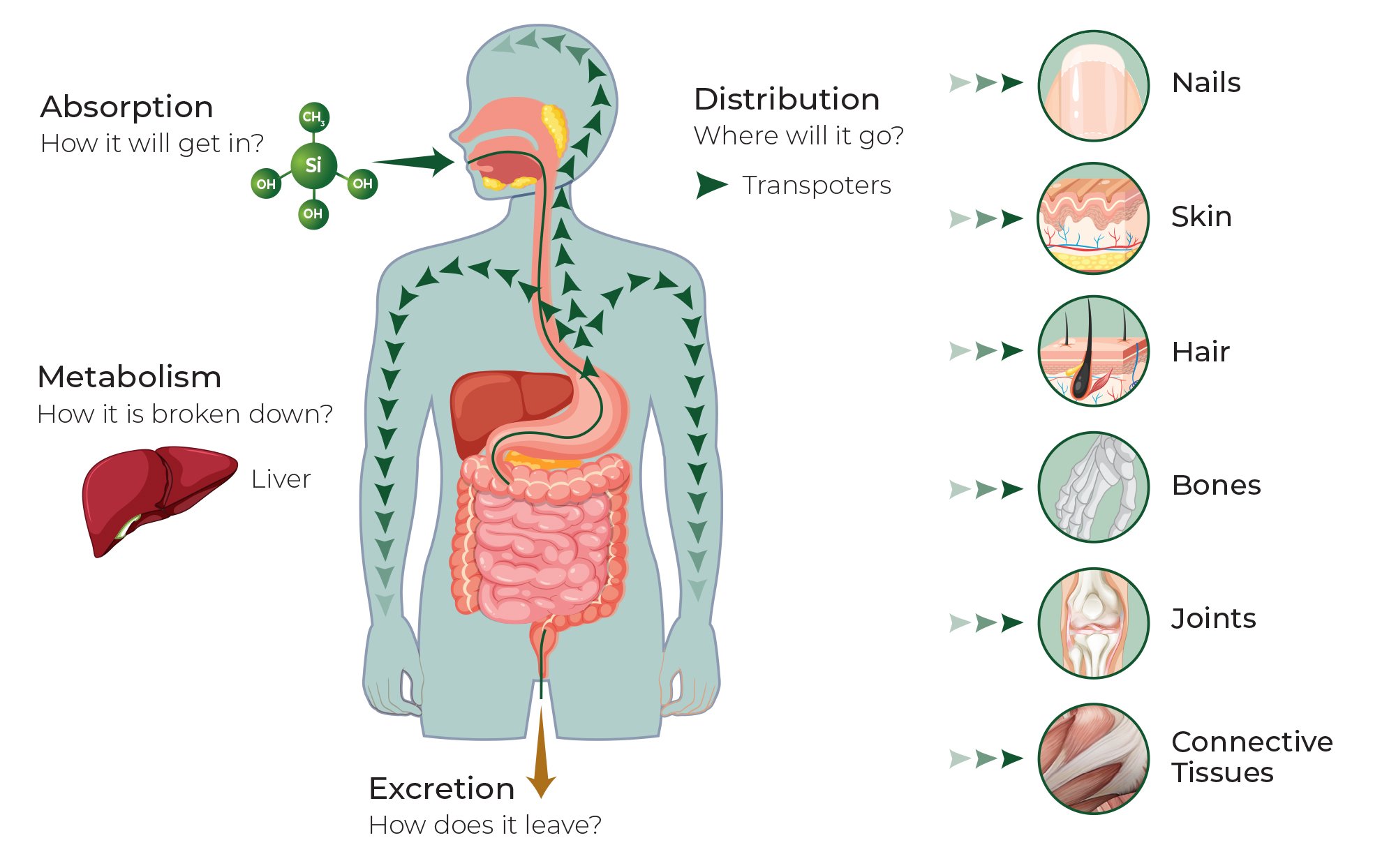 Figure 2.
Schematic diagram of Absorption, Distribution, Metabolism, and Excretion (ADME) of Silica.
Figure 2.
Schematic diagram of Absorption, Distribution, Metabolism, and Excretion (ADME) of Silica.
Bioavailability as a Key Formulation Parameter
From a product development perspective, the effectiveness of silicon depends on its ability to remain:
- Soluble
- Chemically stable
- Resistant to polymerization
- Readily absorbable
Ingredients that aggregate or polymerize during storage or digestion may show reduced functionality.
LIVING SILICA®: Formulation-Oriented Silicon Systems
Silicium Laboratories develops silicon ingredients designed to optimize performance in finished products.
The LIVING SILICA® portfolio includes:
- Monomethylsilanetriol (MMST)
- Acacia gum–stabilized MMST
- Maltodextrin-stabilized orthosilicic acid (OSA)
(See post: Living Silica Ingredients for Bulk Supply and Private Label Development)
These systems are developed to support:
- Stability across formats
- Consistent absorption profiles
- Compatibility with complex formulations
Applications in Nutraceutical Development
Bioavailable silicon ingredients can be incorporated into formulations targeting:
- Bone and connective tissue support
- Skin, hair, and nail applications
- Active lifestyle and healthy aging concepts
Their effectiveness depends on delivering silicon in a stable and bioavailable form.
Supporting Advanced Formulation Strategies
As the nutraceutical industry evolves, there is increasing emphasis on ingredient functionality, bioavailability, and scientific validation.
Understanding the absorption and behavior of silicon enables more informed decisions in ingredient selection and product design.
Technical Documentation and Formulation Support
For specifications, scientific documentation, or formulation guidance:
- +1 (305) 779-0171 | (877) 454 2486
- lab@orgonolivingsilica.com
Or fill out our contact form to connect with our team:
get more information
about our ingredients
LEARN MORE ABOUT
SILICA