.png?width=290&height=50&name=image_1%20(1).png "image_1 (1)")

This is a common question among brand owners and product developers evaluating silicon-based ingredients.
Rather than a universal recommendation, the relevance of silica depends on the target application, formulation objectives, and consumer positioning.
From a product development perspective, silica is most relevant in categories linked to structural health, where its biological role has been studied in relation to connective tissue and extracellular matrix support.
The Biological Rationale Behind Silicon Use
Silicon is a trace element associated with the structural integrity of connective tissues. Scientific literature has explored its involvement in:
- Collagen synthesis (See post: The Importance of Silica in Collagen Synthesis: Biochemical Mechanisms)
- Extracellular matrix organization
- Bone mineralization (See post: The Role of Silica in Osteogenesis: Enhancing Bone Health and Density)
In addition, age-related changes in connective tissue have been linked to processes such as oxidative stress and non-enzymatic glycation, both of which impact tissue elasticity and function over time.
While silicon is not positioned as a therapeutic agent, its inclusion in formulations is often considered as part of a broader strategy supporting tissue structure and resilience.
Lipid Peroxidation
The aggressive action of free radicals causes lipid peroxidation. These particles possess strong oxidizing power. They combine quickly and have a very short but highly destructive lifespan. According to Loeper, silica prevents the formation of these free radicals: this protective action has been evidenced in experiments with cultured fibroblasts.
Free radical production can result from external aggression. At the skin level, it can be triggered by excessive exposure to sunlight and reaches its peak during ionizing radiation treatments. In the medical field, it has been observed that Silica provides irradiated patients with greater tolerance to radiation.
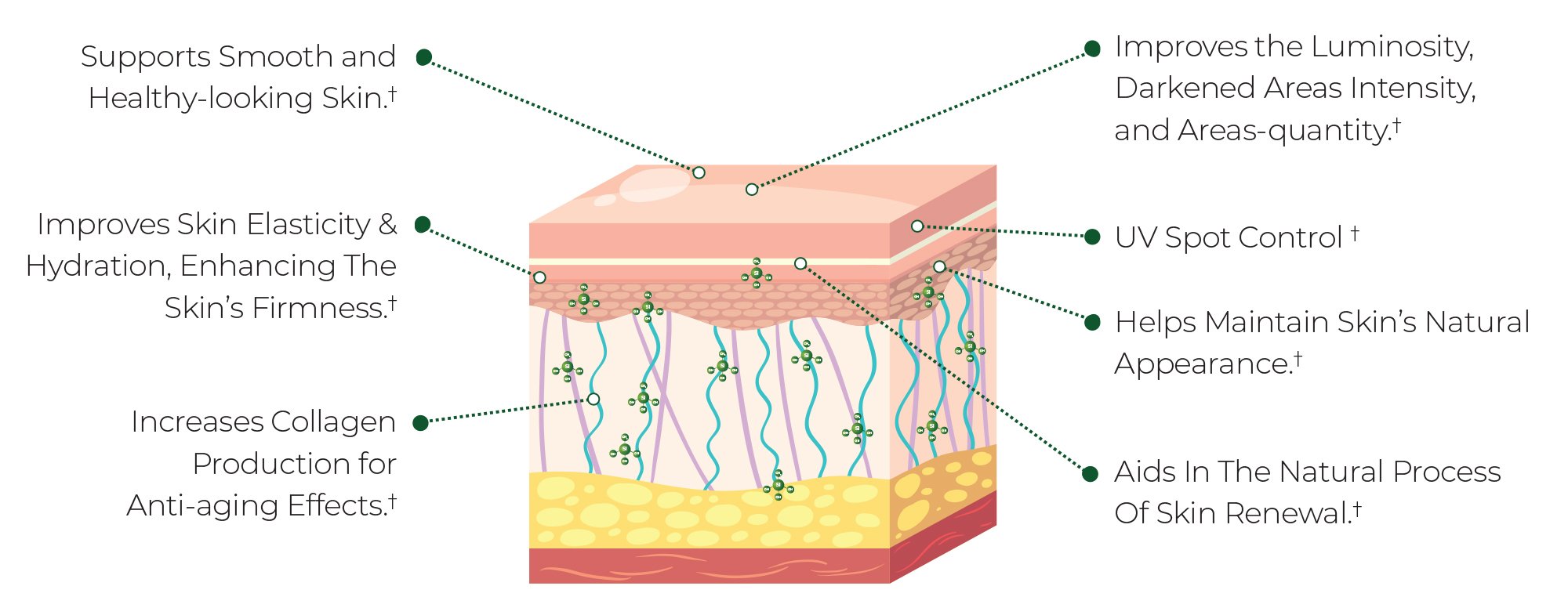 Figure 1. Silica as Monomethylsilanetriol (MMST) helps to improve healthy skin. †These statements have not been evaluated by the Food and Drug Administration (FDA). This product is not intended to diagnose, treat, cure, or prevent any disease.
Non-Enzymatic Glycosylation
The second cause of tissue sclerosis or degeneration and hardening is non-enzymatic glycosylation, a process of structural protein denaturation caused by the binding of glucose molecules. This phenomenon is linked to a deficit of a fundamental element: "Silicon". The glycosylation phenomenon becomes apparent around the age of 35 and increases with age. It reduces the elasticity of arteries and skin.
Relevance in Modern Nutraceutical Categories
Given its functional role, bioavailable silicon is commonly evaluated in the development of:
- Beauty-from-within products (skin, hair, nails) (See post: LIVING SILICA® Supports Healthy Skin, Stronger Hair and Nails)
- Joint and connective tissue support formulations (See post: LIVING SILICA® Strengthens Joints, and Connective Tissues Naturally)
- Bone health and healthy aging solutions
- Active nutrition and recovery products (LIVING SILICA® ENHANCES ATHLETIC PERFORMANCE AND RECOVERY)
These categories continue to show strong global growth, making silicon-based ingredients increasingly relevant from a formulation and positioning standpoint.
Why Bioavailability Is a Key Formulation Factor
Although silicon is naturally present in the diet (e.g., cereals, vegetables, drinking water), its absorption is highly dependent on its chemical form.
Many conventional sources, such as insoluble silica or silicates, present limitations due to low solubility and a tendency to polymerize, which can reduce bioavailability.
For this reason, formulators often prioritize stabilized, low-molecular-weight forms such as:
- Monomethylsilanetriol (MMST)
- Stabilized orthosilicic acid (OSA)
These forms are designed to improve:
- Solubility in aqueous systems
- Stability throughout shelf life
- Absorption potential
Application in Multi-Ingredient Formulation Strategies
In practice, silicon-based ingredients are rarely positioned as standalone actives. Instead, they are integrated into multi-ingredient systems to support specific formulation concepts.
Common applications include:
- Collagen-support formulations (supporting pathways rather than direct collagen supply)
- Beauty complexes with vitamins, minerals, and antioxidants
- Bone health formulations alongside calcium and vitamin D
- Joint support products with glucosamine, chondroitin, or MSM
This approach enables brands to build more robust, mechanism-based formulations while enhancing product differentiation.
Key Considerations for Product Development
When evaluating silica as part of a formulation strategy, several factors should be considered:
- Chemical form and stability of the ingredient
- Compatibility with other actives
- Target dosage and delivery format
- Regulatory positioning and allowable claims
- Alignment with clean-label and plant-based trends
These variables directly impact both product performance and commercial positioning.
A More Strategic Question
Rather than asking “Who should take silica?”, a more relevant question for brands is:
“In which product categories does bioavailable silicon provide meaningful formulation value?”
For companies operating in structural health, beauty, or active nutrition segments, silica can represent a valuable functional component when appropriately selected and formulated.
Conclusion
Silicon is not a one-size-fits-all ingredient. Its value depends on its form, its integration within a formulation, and the application it is intended to support.
For brands developing next-generation nutraceuticals, bioavailable silicon offers an opportunity to:
- Support structure-focused product concepts
- Align with clean-label and plant-based positioning
- Differentiate through scientifically grounded formulation strategies
Contact us today to request technical documentation or samples for your next formulation.
- +1 (305) 779-0171 | (877) 454 2486
- lab@orgonolivingsilica.com
Or fill out the form:
get more information
about our ingredients
LEARN MORE ABOUT
SILICA